
The Time I Tried Every Technique
Looking back at the years I spent trying to figure out how to breathe, I tried a lot of techniques.
Diaphragmatic breathing from my singing years.
Box breathing. 4-7-8. Pursed lip.
Coherent breathing. Alternate nostril.
You name it...
Some of them I liked. Some of them annoyed me. Some of them felt silly.
Then I found circular breathing and that's the one that helped me the most...
but also did the most damage.
I didn't know it at the time, but what started as a powerful practice became a habit that had me unconsciously hyperventilating all day, every day.
I was wired, tired, and foggy.
Looking back, I can see I was always reaching for the next technique. Unconsciously asking the same question...
Can't I just find something to make me feel better?
Always searching for the thing to fill the void.
The shift came when we started learning about behavioral science and respiratory science.
We learned about the breathing reflex, which intrigued us because it was centered around the urge to breathe.
I was uncomfortable with the urge to breathe...
That's why I was always reaching for another technique.
What I started to understand was that the more I allowed the body to breathe, the more I connected with this reflex, the more I was in a well-regulated state without having to find the right technique. 🙌🏼
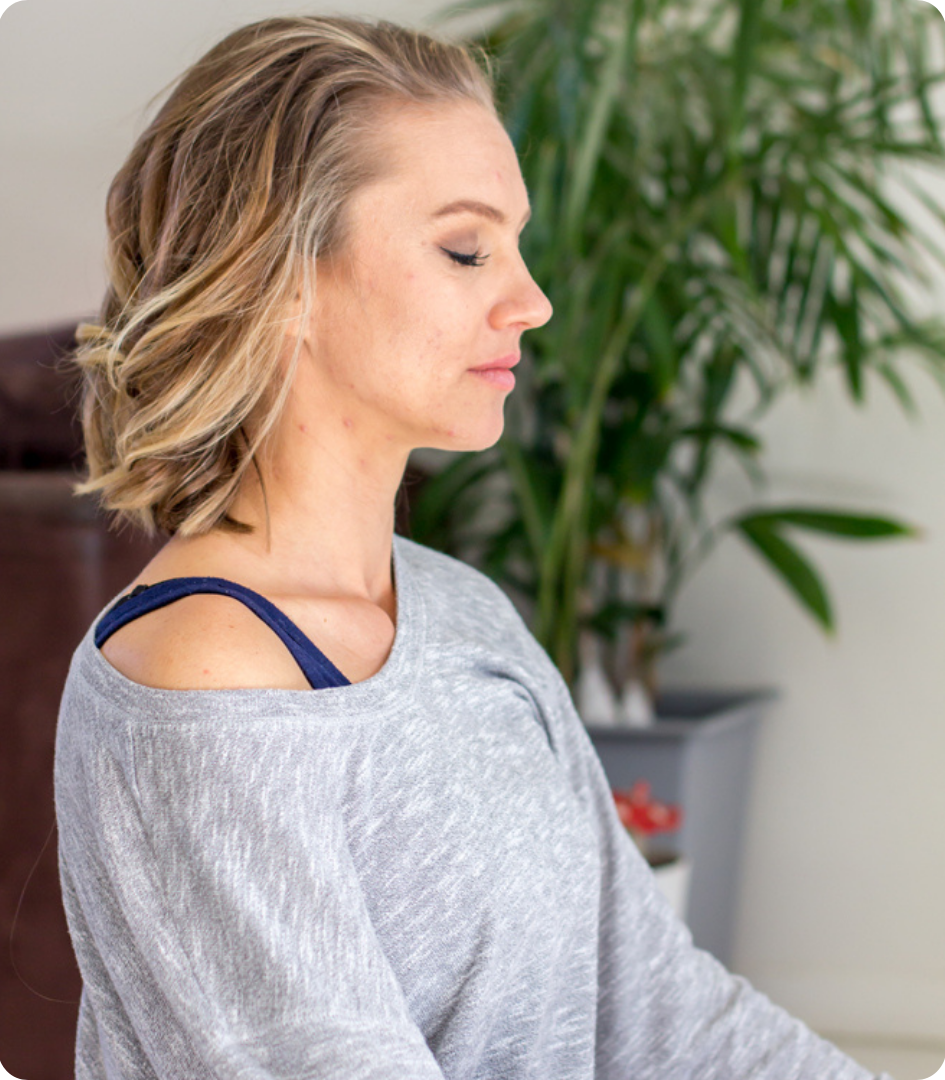
This was a huge paradigm shift.
I'm someone who feels accomplished by doing something.
So I was learning that to get to a regulated state, I had to stop controlling my breathing. 😳 I had to step away from control and trust the body to do what it was already built to do.
It took a couple of months to break the habit of doing something to feel better. Once I did, something I didn't expect started happening…
So... I am a the peacemaker in our family.
Both growing up and in our current family.
Anytime conversations had a charge to them, an argument between the kids or a disagreement with Shane (my husband), or anything that felt like confrontation, I would do what I could to try to avoid it.
When I couldn't avoid it, I'd go foggy. It was like having whole conversations underwater. I even had a hard time being clear on what was happening sometimes.
I would get triggered, the body would react, I'd control the breath or brace my abdominals and hold it, like I was waiting for impact. The my mind would react to what my body was doing and I would make all kinds of stories about what was happening.
The situation around me was stressful and my body was stressful too.
I was overwhelmed by both.
It wasn't until I started pulling myself out of the fog that I realized…
It was a breathing problem.
When I started observing how the breath was reacting and then allowing it to settle... I stopped reacting. I started letting the situation unfold naturally, leading with curiosity instead of control.
I remember an exact moment...
Standing in the kitchen, confrontation happening around me, and for the first time I wasn't stressed out about it!
What I found is that it's hard to regulate in the moment when the body is fighting against itself.
When the body is allowed to do what it's built to do, the reaction moves on faster if any reaction at all.
My reactivity stopped running the show.
That's the part I wish I knew earlier.
And it sits at the center of this week's newsletter.
Grateful to have you a part of our community.

Featured Insight of the Week...
Is there a right way to breathe?
Almost every breathing teacher, app, and article
right now answers this question with a technique.
Or with prescriptive breathing.
Breathe like this and you will feel like that.
The thing is, our breathing is like a fingerprint.
It's unique to each of us.
What helps one person with their anxiety
won't necessarily work for another.
Each technique might promises to calm you down,
help you focus, give you more energy, or help you sleep.
And because every body is unique, prescriptive breathing
as a one-size answer just doesn't work for everyone.
It goes against what both behavioral science
and respiratory science actually show.
Here's the part most teachings leave out.
The body already knows how to breathe to regulate itself.
It has a reflex for it.
A built-in mechanism that regulates respiration
based on what's happening in the body,
moment to moment, without any technique needed.
External demands, internal demands,
and the body's interpretation of both.
The reflex adapts organically and endogenously.
This is where behavioral science and
respiratory science come together.
Respiratory science tells us how the reflex works.
Behavioral science tells us what we do that interrupts the process.
Most of us have spent years interrupting it without realizing.
Chronic overbreathing. Bracing the body under stress.
Reaching for a technique every time something feels off.
The body adapts to whatever we do repeatedly,
including breathing techniques.
These techniques becomes the new pattern.
The reflex gets overridden before it can rebalance the chemistry.
This is why a technique can feel like it works in the moment
and still leave the underlying pattern unchanged.
The technique addresses the symptom.
The reflex is what restores regulation and gets to the root.
Shane has an analogy I love.
Breathwork is to reflexive breathing
what sprint training is to walking to the mailbox.
Both are legitimate. They have different jobs.
Techniques are popular. They're great.
There's a time and a place to use them...
But the body doesn't really need them to regulate.
What the body needs is for us to stop interrupting an endogenous process.
We go deep into the science of this on the blog.
This week in Behavioral Breathwork
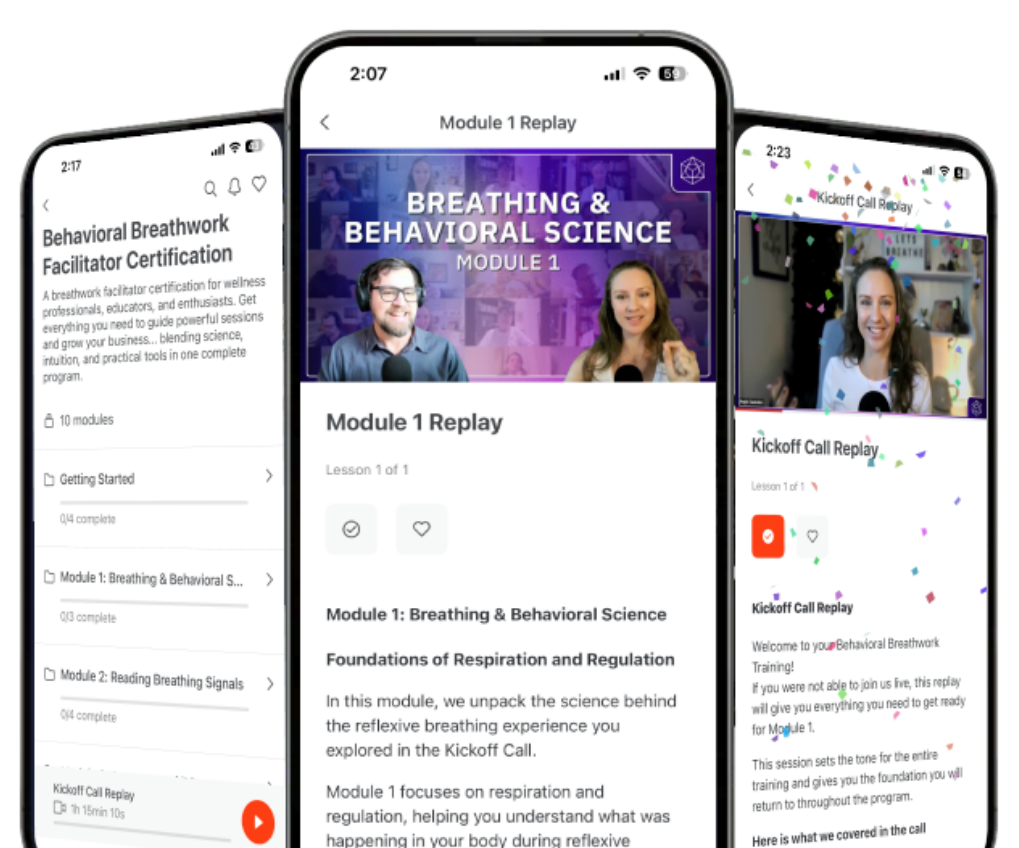
We're one week into our Behavioral Breathwork Training.
Kickoff call done. Module 1 just dropped today.
The first thing we asked everyone last week was to practice connecting with the breathing reflex. Allowing the body to breathe them.
What we're seeing in the Telegram group is fascinating.
For a lot of people, this is surprisingly difficult to understand.
I (Angie) found it difficult at first too.
After years of breathing techniques and high-stress living, we've all become really good at controlling the breath without realizing it…
The idea of allowing the breathing reflex to breathe us can feel foreign.
Module 1 takes us into the behavioral science and respiratory science of breathing itself.
How breathing and respiration actually work together.
The part that almost no one really teaches.
If you'd still like to join us for this round, the doors are technically closed but we'd love to welcome you in anyway!
NEW HERE?
Begin your personal journey
🔗 Start the Free 7-Day Experience
If you’d prefer to begin with a simple personal experience, you can start with our free 7-Day Reflexive Breathing Experience.
It’s a short guided exploration to help you notice how your own breathing patterns respond to stress and settling.
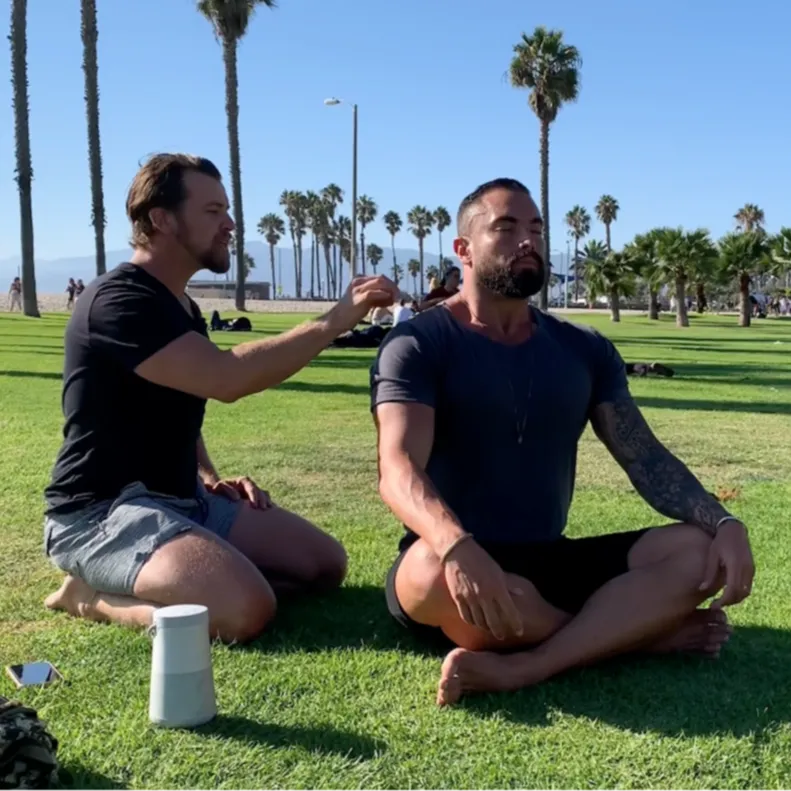
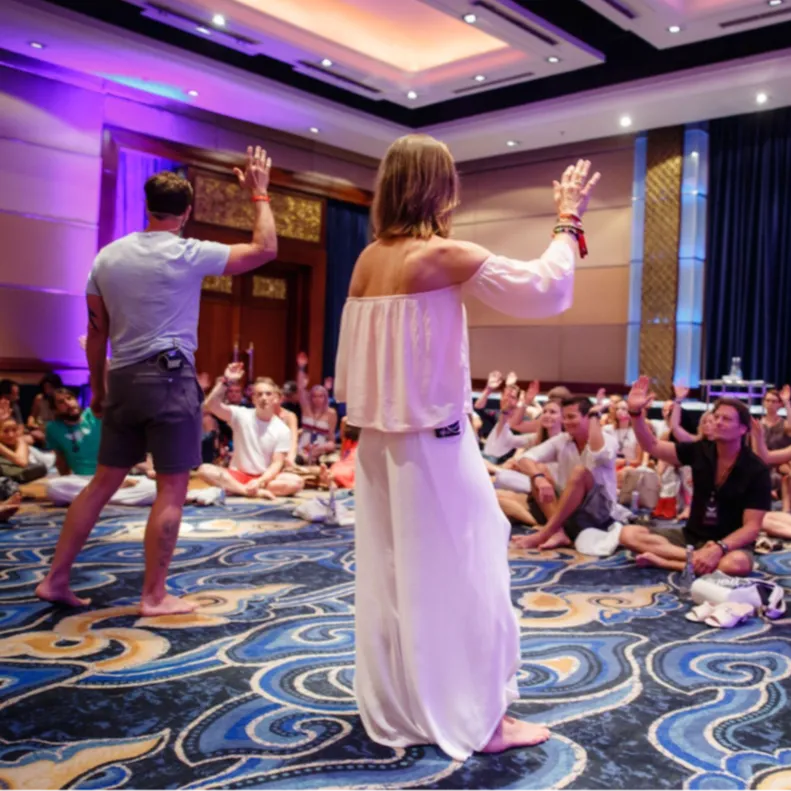
KEYNOTES, WORKSHOPS, & PODCASTS
🔗 Book Shane and/or Angie For Your Next Event
We offer workplace keynotes and trainings grounded in behavioral science and breathwork, helping teams understand how stress develops as a learned response and build practical regulation skills they can use immediately.

Missed a Newsletter? Catch Up Anytime!
If you’ve recently joined or just want to revisit past insights, tools, and breathing practices... we’ve got you covered!
👉 Browse All Our Previous Newsletters Here


Responses