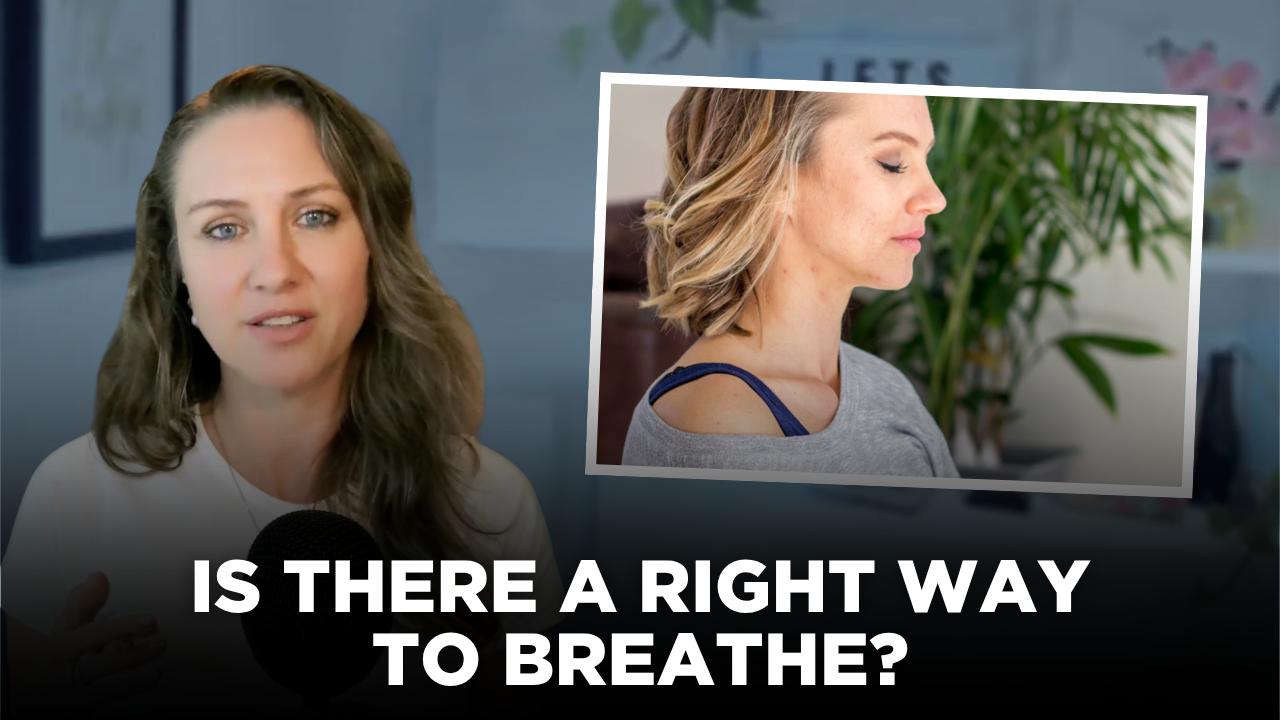
Is there a right way to breathe?
Written by Angie Saunders
When searching for the right way to breathe, it’s easy to end up swimming in a flood of advice.
Belly breathing. Box breathing. 4-7-8. Pursed lip. Coherent breathing. Alternate nostril. Slow deep breaths. Long exhales…
Every wellness app, every breathwork teacher, every health article seems to have a different answer.
And underneath all of them is the same assumption…
That breathing is something to do correctly.
That somewhere out there is the right technique, the right rhythm, or the right count.
So someone tries one. It works for a while. They try another. Maybe that one feels better.
They start layering them. They read another article. They watch another video.
And somewhere along the way they realize they have been doing something with their breath for so long that they can't remember what it feels like to not be doing something with it.
This is one of the most common patterns we see. And it usually means the wrong question is being asked.
What if the question itself is the problem?
The breathing science we draw on in this article comes from a course we have developed alongside Dr. Peter Litchfield, a pioneer in behavioral breathing science with over 60 years in the field.
What his work shows is that the conversation about breathing has been stuck on the surface for a long time. The wellness world talks about mechanics. How fast we breathe. How deep. Through which nostril. With which muscle. What count. How long to pause.
But mechanics are only one half of the picture. The other half is the chemistry the mechanics produce. And that chemistry is what regulates almost everything else in the body.
In Peter's words: "What a lot of people who do breathwork completely miss is the respiratory part of it. They focus so much on the mechanics."
The mechanics are what we can see and feel.
The chest, the belly, the rate, the rhythm.
Respiration is what those mechanics do inside the body.
The gas exchange. The pH of the blood. The CO2 levels that determine how oxygen gets delivered to the tissues. The acid-base balance that runs every cell, every organ, every breath.
One could technically have beautiful mechanics and still be working against their own respiration.
This is the foundation of behavioral breathing science: "The mechanics have to serve respiration, and many times they don't."
How breathing actually regulates the body's chemistry
Underneath every breath we take is an equation called the Henderson-Hasselbalch equation. Peter refers to it as the master equation of respiration.
In simple terms:
pH = bicarbonate concentration (regulated by the kidneys) / CO2 concentration (regulated by breathing)
The pH of the blood, the lymph, the fluid that surrounds every cell in our body, sits inside a very narrow healthy range. Slightly alkaline. Around 7.35 to 7.45.
The kidneys regulate one half of this equation, but they work slowly. Hours and days. Breathing regulates the other half, in real time, breath to breath.
Which means how we breathe is the fastest mover of blood pH in our body.
And this is where Peter's framing becomes essential: "Taking control of breathing means taking control of this equation."
When we grab the breath and run a technique on top of what the body is already doing, we’re not just changing the rate or the depth. We’re changing the chemistry.
Sometimes that change is useful and supportive. Often it is not.
And most people who teach breathing techniques are not teaching their clients how to tell the difference.
What is overbreathing?
Most dysfunctional breathing falls into one category. Overbreathing. Sometimes called hyperventilation, though that term carries clinical and cultural weight, so behavioral breathing science prefers overbreathing.
What overbreathing really means is that CO2 is dropping too far, pH is rising, and the body is moving into respiratory alkalosis.
When this becomes a habit, the consequences ripple through the entire system.
Bronchial constriction. Heart palpitations. Vasoconstriction in the brain, reducing blood flow by up to 50 percent. Lactic acid building up where it shouldn't. Antioxidant capacity dropping. Bicarbonate stores becoming depleted as the kidneys try to bring pH back into range.
Most of these effects are invisible to the person experiencing them. They get diagnosed as something else. Anxiety. Burnout. ADHD. Hormonal imbalance. Sometimes a heart investigation. All of these can be downstream of a breathing habit that no one ever thought to look at.
None of this is a diagnosis. If someone is experiencing any of these symptoms, of course they should seek appropriate medical care.
What behavioral breathing science adds is that breathing is worth assessing alongside everything else.
The psychoanalyst Herbert Fensterheim, in 1994, made exactly this point:
"Given the high frequency of incorrect breathing patterns in the adult population, attention to the symptoms of hyperventilation, that is overbreathing, should be a routine part of every psychological evaluation, regardless of the specific presenting complaints."
He went on to describe how breathing affects patients differently. In some cases it may be the central problem directly producing symptoms. In other cases it may magnify, exacerbate, or maintain symptoms brought on by other causes.
He was writing for psychotherapists. The same applies across health, wellness, movement, and clinical work. Breathing belongs in the picture.
This is why behavioral breathing science treats the question of how to breathe as a science question first, before it is a wellness question.
How the body regulates breathing on its own
Here is the part most people never get told.
The body has receptors in the aorta, the carotid arteries, and the brainstem that are sensitive to the pH of the blood, the concentration of CO2, and the concentration of oxygen. These receptors send signals to specialized centers in the brainstem that regulate breathing from one breath to the next.
This regulation is not something we need to learn. We were born with it. It is exquisitely sensitive. It adjusts continuously, breath by breath, moment by moment, in response to whatever the body needs right now.
In Peter's words: "It's about balancing that equation and working within the envelope."
The envelope is the normal healthy range of pH. The body is built to stay inside it. The reflexes that govern breathing exist for exactly this reason. To keep the chemistry stable regardless of what is happening externally.
And here is one of the most counterintuitive parts of all of this: "You don't have to relax to have good breathing from a respiratory point of view."
Calm isn't required. Meditation isn't required. A peaceful environment isn't required. Healthy respiration was designed to work whether we are running, falling asleep, having a difficult conversation, or watching a movie with someone we love.
The body is robust. It will do its job, unless we get in the way.
So, is there a right way to breathe?
There isn't a right technique. There isn't a count or a rhythm that works for everyone.
Breathing is like a fingerprint. It is unique to each person.
What helps one person with anxiety will not necessarily work for another. What calms one body down will activate another.
But there is a right way to think about breathing…
Mechanics serve respiration.
Whatever we do with the breath, mechanically, needs to support the chemistry.
Not work against it.
When the mechanics align with what the body's reflexes are already trying to do, breathing supports regulation. When the mechanics override what the reflexes are trying to do, breathing becomes the source of dysregulation.
Or to use Peter's framing directly: "To talk about breathing without understanding how it's related to respiration is a serious oversight."
The right way to breathe is whatever way allows respiration to stay balanced.
And the only way to know that for sure is to learn what our respiration is actually doing.
What changes when the answer stops being a technique
When the answer is no longer a technique, several things start to change.
The search for the next breathing method begins to slow down.
The assumption that difficulty with breathwork is a personal failure begins to shift.
The prescriptive advice that has been everywhere for the last decade starts to look different. Awareness of breathing changes too.
It becomes something to understand rather than something to control.
This is the work of behavioral breathwork. Less about learning techniques.
More about understanding what the breath has been doing all along,
and what it can do when it is no longer being interrupted.
The body already has a built-in system for regulating its own respiration.
It was there at birth. It is still there now.
The question is whether breathing habits are working with that system or against it.
ON-DEMAND NOW AVAILABLE!
Behavioral Breathwork Training On-Demand
Learn how to understand breathing behavior in real time and guide it with clarity. This on-demand training gives you a practical, physiology-informed framework you can apply in your own practice and with clients.
SUBSCRIBE NOW!
Online Breathing Academy Newsletter
Join our newsletter for thoughtful conversations about Behavioral Breathwork, regulation, and how stress develops as a learned response.
This is where we share more context, more nuance, and the reflections that don’t always make it online.
We won't share your details. Unsubscribe at any time.