
A decade of performance anxiety, until I understood this...
My performance anxiety started in Year 12.
One underprepared performance that ended in public embarrassment, and after that, the anxiety was always running quietly in the background anytime I went to perform.
I kept performing for over a decade anyway.
I got into an improv comedy troupe, did theatre, even sang backup at the 2007 Grammys for Gnarls Barkley.
But the one that hit me the most was the semifinals for The Search for the Next Pussycat Doll show, filming for national TV… Right in the middle of my solo, my body went into a panic. I lost my timing in the music. I was asked to leave the stage before the song was over.

I stopped performing after that.
Around the same time I met Shane and moved to Australia.
I found it hard to even present our business to a small group, but I kept trying, acting like everything was fine while I was in a panic with a thumping heart and a cold sweat.
It wasn't until after we got into the breathing space, about to present to a room of chiropractors and their clients, that the same feeling came back.
That familiar rise of panic, right before walking on to speak.
This time was different though. I had learned a few things. I had knowledge of breathing behaviors, and what we call the breathing shapes.
I cycled through them in real time. First I met my anxiety with how it wanted to breathe, in a Circle. Then I eased into a Triangle. Then a Square. I softened my belly, released my shoulders, relaxed my jaw.
For the first time, I was not reacting to the sensations in my body in the same way I had before. I knew the sensations were really just a physiological reaction to a very real fear I had of embarrassing myself.
From a science perspective, it was respiration going off balance. This time I was responding to what my body was doing, working with it instead of against it.
The difference this time is that I understood why it was behaving the way it was. I could have compassion for my physiology and feel grateful for how it was trying to protect me. I could finally see what was happening, and let my body lead instead of fighting it.
I regained my composure, and we walked out and presented in a way that helped others in the room learn something about their breathing too.
So why does the body feel so out of control in moments like this, and how can we work with it instead of fighting the system?
That question sits at the base of this week's newsletter.
Grateful to have you part of this community,

Featured Insight of the Week...
How Does Anxiety Affect Breathing?
The body is a learning system.
When something feels threatening,
the body reaches for a breathing pattern that might have helped before.
Something that brought relief, or a sense of control.
It learned that response in a moment of real stress,
and it files it away for the next time you are in a similar situation.
This is called state-dependent learning.
The pattern is tied to the state it was learned in,
so when a similar moment returns,
the breathing reaction returns with it.
The body is matching the moment to a response it already has on file.
This is why breathwork or breathing techniques can sometimes backfire.
They trigger these same reactions.
Here is what makes this behavioral.
The trigger does not change the body's chemistry directly.
The trigger fires the learned breathing pattern,
and the breathing is what changes the chemistry.
The breathing behavior is the driver.
And the breath has one job. It is protecting the next breath.
So it runs whatever it learned will keep us safe,
even when that pattern is the very thing
creating the sensations we are reacting to.
Here is the part that tends to go unnoticed.
The reactive breathing pattern lowers CO2,
and the drop in CO2 creates real sensations that can be frightening.
A racing heart. Tingling. Lightheadedness. Tightness in the chest.
The body reads those sensations as more evidence of threat,
and breathes harder still. The sensation becomes the next trigger.
This is the loop, and it can run on its own
long after whatever started it is over.
This is why I stopped performing for so long, because it was so overwhelming for me.
What keeps the loop running is how the sensations get interpreted.
If it feels like danger, it feeds the stress response pattern.
If it is recognized as the body doing its job,
it can begin to make its way to relief or regulation.
Same sensations, different responses.
The work is not in finding the right breathing technique.
It is in understanding what the breath is responding to.
We go into the full science on the blog,
including what is happening in the body when anxiety takes over,
and why awareness is the first step back to regulation.
This week in Behavioral Breathwork
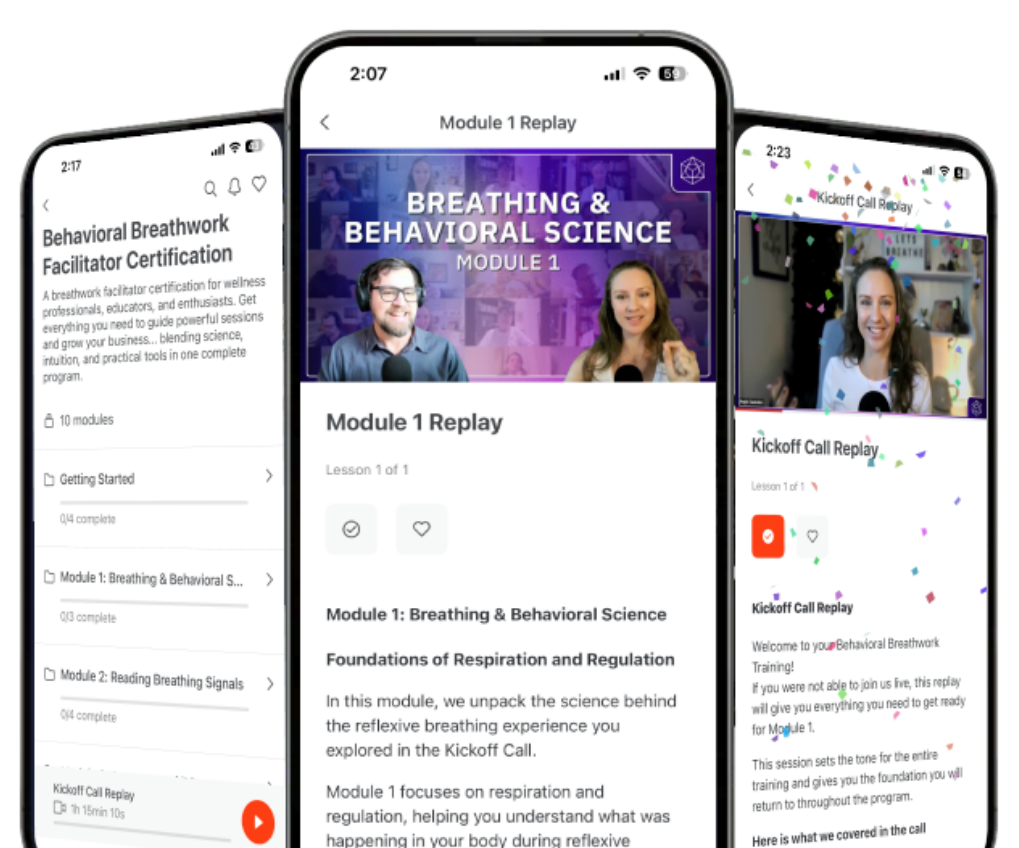
This week we moved into Module 3, Awareness of Triggers.
This is where the training shifts from the science of breathing into everyday life.
We looked at the three kinds of triggers that set off a learned breathing pattern, external, internal, and sensation-driven, and how a pattern that once brought relief can quietly turn into a loop that runs on its own.
The conversation on our live call went deep. One participant shared this:
"I always thought my whole life that I underbreathe because I always hold my breath, but I didn't realize until the last sessions that I compensate this holding with overbreathing."
This is the kind of recognition this course is built to create.
Not the right technique to find, but a pattern to understand clearly for the first time. That kind of understanding is what allows an old pattern to fade away, making room for the body to find a healthier, more balanced way to regulate.
If you'd still like to join us for this round, the doors are technically closed but we'd still love to welcome you in.
NEW HERE?
Begin your personal journey
🔗 Start the Free 7-Day Experience
If you’d prefer to begin with a simple personal experience, you can start with our free 7-Day Reflexive Breathing Experience.
It’s a short guided exploration to help you notice how your own breathing patterns respond to stress and settling.
KEYNOTES, WORKSHOPS, & PODCASTS
🔗 Book Shane and/or Angie For Your Next Event
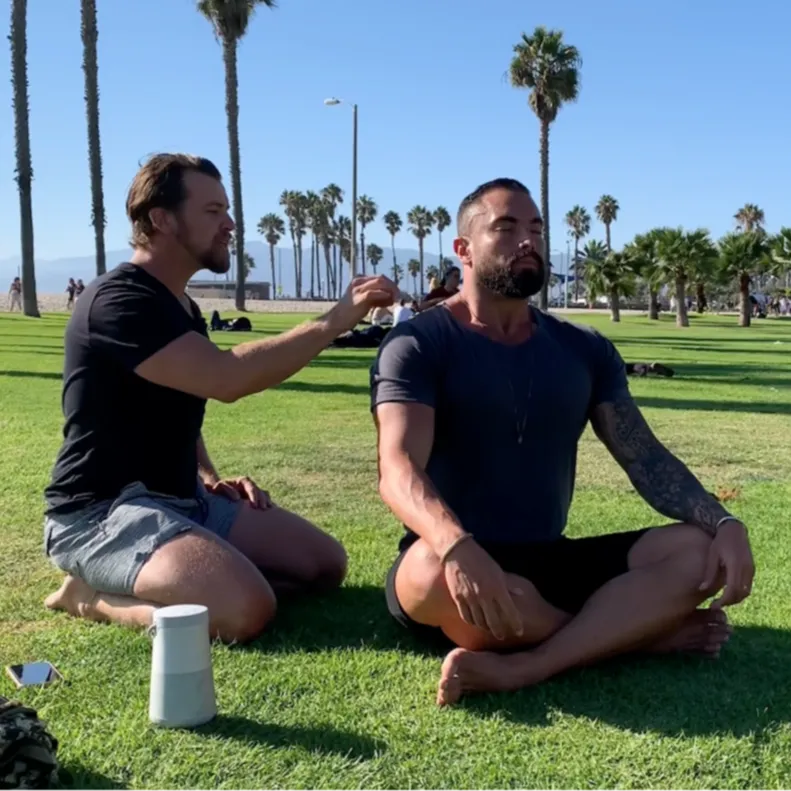
We offer workplace keynotes and trainings grounded in behavioral science and breathwork, helping teams understand how stress develops as a learned response and build practical regulation skills they can use immediately.

Missed a Newsletter? Catch Up Anytime!
If you’ve recently joined or just want to revisit past insights, tools, and breathing practices... we’ve got you covered!
👉 Browse All Our Previous Newsletters Here

Responses