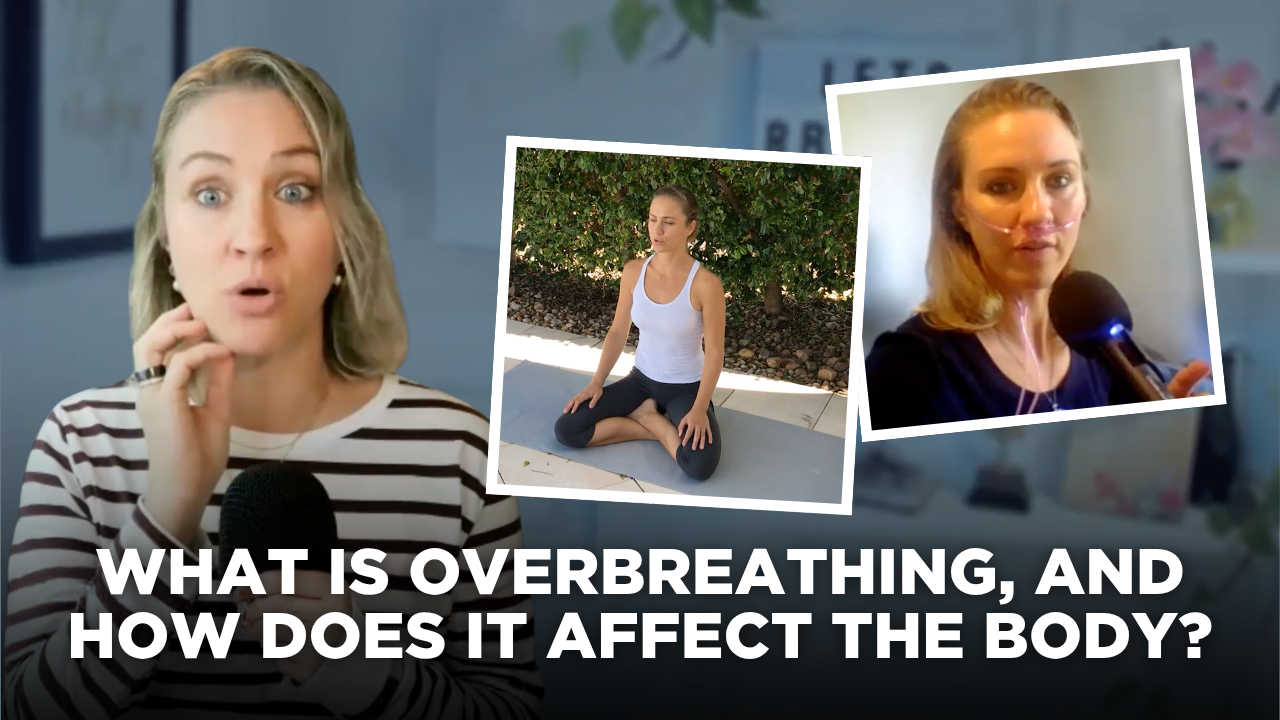
What is overbreathing, and how does it affect the body?
Written by Angie Saunders
It has been estimated that breathing habits account for roughly 60% of emergency ambulance calls in major US city hospitals (Fried, R. Breathe Well, Be Well, 1999, p. 45).
Not a disease. Not an emergency in the usual sense. A breathing habit, often learned early in life, producing symptoms so real and so alarming that people call for emergency help.
And yet the cause is almost never identified, its effects attributed to something else entirely.
I spent years as one of those people. Symptoms that did not add up. A low-level anxiety, a sense that something was wrong, and no clear answer for why I felt that way. In certain situations that low-level anxiety would get triggered and feel overwhelming. The cause, it turned out, was not in the health of my body. It was in how I had learned to breathe.
People who work with clients know the feeling. The work is helping, but something underneath is still driving the stress. An itch that is not getting scratched.
In a great many cases, the missing piece is breathing.
How breathing actually works
Breathing is usually thought of as the body's way of taking oxygen in. That is part of it. The larger and less understood half is what breathing does with carbon dioxide.
Every cell produces carbon dioxide as it turns fuel into energy. It moves into the blood, and breathing is the main way the body releases it. Each exhale lowers the level of CO2 in the blood. Each inhale brings fresh air in. The two happen together, but they are not the same job.
Here is the part that flips the usual assumption. CO2 is not simply waste to be cleared out as fast as possible.
We met Dr. Peter Litchfield in 2020 and have been diving deep into his work ever since. He is a research psychologist who specializes in behavioral physiology, and is one of the leading researchers in the world on breathing and behavioral science. We will refer to his work often, and here are some of the most important things we have learned that we want to share.
CO2 regulates the pH of the blood, and pH has to stay inside a very narrow band. It also governs how readily oxygen is released from the blood into the tissues and organs that need it. Lose too much CO2 through overbreathing, and the body's chemistry tips out of balance.
The body monitors all of this without any conscious input. Sensors track CO2 and pH in the blood and signal the brainstem, which adjusts the rate and depth of breathing on its own, breath by breath. This is the breathing reflex, the system that keeps breathing going during sleep, during a meal, during a conversation, during anything other than thinking about it.
So healthy breathing is not a matter of how deep, how slow, or which technique. It is a matter of whether the body has the freedom to regulate itself, or whether a learned habit of controlling the breath is quietly getting in the way. When the body is left to do its job, it holds its own chemistry in a healthy range, breath by breath.
We covered this in an earlier article on whether there is a right way to breathe.
What is overbreathing?
Overbreathing is exactly what it sounds like. Breathing more than what the body actually needs.
Many people know it by another name: hyperventilation. Dr. Litchfield moved away from that word, and for good reason. It carries a connotation of panic, someone visibly distressed, gasping for air, so most people never recognize it in themselves. Yet a person can be overbreathing while sitting calmly, even in a meditative state, breathing slowly. It has nothing to do with looking panicked. This is why overbreathing is the more accurate word, and the one we use.
It is a learned breathing behavior, one the body has come to rely on, often picked up as a way of coping during a stressful time and carried forward long after. It is also the most common form of dysfunctional breathing in otherwise healthy people. And most of the time, the person doing it has no idea.
What is hypocapnia?
Overbreathing is the behavior. Hypocapnia is what it produces.
When the body breathes off more carbon dioxide than it makes, the level of CO2 in the blood drops. That state has a name: hypocapnia. Low carbon dioxide. And it is where the trouble actually begins, because of what CO2 does once it is in short supply.
Most people, when they think about breathing at all, think about oxygen. Getting more of it in. Some even track it, chasing a high reading on a pulse oximeter, assuming that closer to 100 percent must be better. Dr. Litchfield calls this view "uninformed and simplistic." Oxygen matters, of course. But more oxygen in the blood is not the goal, and it is not the thing most people are short on.
Here is the reframe that changes everything. The problem is not too much oxygen. It is too little carbon dioxide.
CO2 is what allows oxygen to be released from the blood into the tissues that need it. Think of the oxygen in the blood as money in the bank. CO2 is the card that lets the body actually withdraw it. Without enough CO2, the oxygen is there, fully stocked, and the tissues still cannot reach it. This is why overbreathing can quietly leave the body short, even while the blood looks well supplied.
Low CO2 also tips the blood more alkaline, a state called respiratory alkalosis. The term is simpler than it sounds: it just means the blood's chemistry has shifted out of its healthy range as a result of losing too much CO2.
And here is what makes it so hard to catch from the inside. The body adapts. When a lower CO2 level is held long enough, the system that monitors it begins to treat that lower level as normal. The body comes to prefer a lower CO2 level than is healthy, and it keeps itself there through unconscious patterns. So when CO2 starts to climb back toward where it should be, the body reads that correct level as wrong. It registers a feeling of not getting enough air, and the response is to reach for more, which lowers CO2 right back down again.
How does overbreathing affect the body?
This is where chemistry turns into lived experience. When CO2 drops and the blood turns more alkaline, a physiological cascade follows. Two effects matter most.
The first is known as the Bohr Effect. With less CO2 present, hemoglobin holds onto its oxygen more tightly and releases less of it to the tissues that need it. The blood may be well oxygenated and still deliver less where it is needed.
The second is constriction. Low CO2 narrows the blood vessels, including the ones feeding the brain. Litchfield's work documents that in significant overbreathing, blood flow to the brain can fall by as much as 50 to 60 percent in under a minute.
Less oxygen released, and less blood to carry it. The result is a wide spread of sensations: lightheadedness, a racing heart, tingling in the hands or face, a tight chest, brain fog, fatigue that arrives for no clear reason. Because the effects touch nearly every system, the symptoms scatter across the body and rarely point back to the breath. This is exactly why the pattern gets missed, and why Litchfield notes these effects are so often filed under unexplained symptoms or attributed to something else.
A note worth stating plainly: these same symptoms can have other causes, some of them serious. This is educational, not a diagnosis. Anyone experiencing them, especially if new, persistent, or severe, should get checked by a medical professional. Disrupted breathing chemistry can mimic and worsen many conditions, which makes breathing one layer worth assessing alongside proper care, not a replacement for it.
The order is the thing to remember. The breathing changes first. The chemistry follows. The sensations come after. By the time a feeling gets named, as anxiety, as panic, as something being wrong, the physical chain has often already run its course. The experience is real. The starting point is just further back than it looks.
What causes overbreathing?
Overbreathing is learned. That is the heart of the behavioral view, and it is good news, because what is learned can change.
It usually begins as something useful. During a stressful chapter, the body finds a breathing pattern that brings short-term relief, a way to feel in control, to brace for protection, or to discharge tension. The pattern works in the moment, so the nervous system files it as a solution and reaches for it again the next time something similar comes along.
Over time it becomes a habit, running below awareness, long after the original stress has passed.
There is a deeper mechanism underneath this, called state-dependent learning. A breathing pattern learned in a particular emotional state gets bound to that state. When the state returns, the breathing returns with it, automatically. It is the same principle researchers have studied for decades in habit and dependence. The body is not malfunctioning. It is running a learned response, faithfully, in the situations it was learned in.
Triggers come in three broad kinds.
- External, from the environment: conflict, deadlines, a crowded room.
- Internal, from within: an emotion, a memory, anticipation, fatigue.
- Sensation-driven, where the body reacts to the very sensations the overbreathing has already created, which keeps the loop turning.
Often more than one is at work at once.
Underneath all three, there is often a belief. That a big breath means more oxygen, and more oxygen is better. The belief drives a bigger breath, the bigger breath lowers CO2, and the low CO2 creates a feeling of not getting enough air. The belief feels confirmed, so the pattern deepens. It is one of the most common ways overbreathing takes hold, and one of the hardest to spot, because it feels like answering a real need.
Beyond the chemistry
The effects of overbreathing reach past the obvious symptoms, into state and consciousness, which is where breathing becomes genuinely interesting…
Because overbreathing changes brain chemistry and blood flow, it changes state. It can produce dissociation, a sense of distance from oneself, altered perception, a shift in how the world feels. Sometimes this is distressing. Sometimes, in the right context, it becomes a doorway. The same physiological change that drives a panic loop in one setting can, when met with awareness, open access to memory, emotion, and parts of the self that are otherwise hard to reach. This is part of why intentional breathing practices can be so powerful, and also why they can backfire so badly. The physiology is the same. The meaning made of it is everything.
This is the layer where breathing stops being only mechanics and chemistry and becomes behavioral, psychological, even, for many, spiritual.
The breath sits at the meeting point of body and mind, and learning to work with it can go far beyond a set of symptoms.
What this means, and where it leads
For the everyday person carrying unexplained symptoms, this changes things...
It offers a different question. Rather than asking what is wrong, it becomes possible to ask what the breathing is doing, and whether the body has quietly learned a pattern that is influencing how things feel. That question opens a door that diagnosis alone often cannot.
For the practitioner, facilitator, or coach, it matters even more...
Litchfield's position is direct: anyone working with breath should understand how changing breathing mechanics immediately and precisely alters breathing chemistry. Without that understanding, a well-meaning technique can drive a client further into the very pattern it was meant to relieve, and neither person understands why.
With it, the same practitioner can support genuine regulation instead of reinforcing a loop.
And the way in is not a better technique applied harder. It begins one step earlier, with awareness. Awareness precedes regulation. The aim is not to control the breath, but to see the pattern clearly, because a pattern seen is a pattern that can finally change. From there, the body's own reflex, the system designed to keep its chemistry in balance, can begin to do its job again.
That is the foundation of Behavioral Breathwork. Not a set of techniques to perform, but an understanding of what breathing is actually doing, and the awareness that makes change possible. It is where the work begins.
ON-DEMAND NOW AVAILABLE!
Behavioral Breathwork Training On-Demand
Learn how to understand breathing behavior in real time and guide it with clarity. This on-demand training gives you a practical, physiology-informed framework you can apply in your own practice and with clients.
SUBSCRIBE NOW!
Online Breathing Academy Newsletter
Join our newsletter for thoughtful conversations about Behavioral Breathwork, regulation, and how stress develops as a learned response.
This is where we share more context, more nuance, and the reflections that don’t always make it online.
We won't share your details. Unsubscribe at any time.