Why Is It Hard to Relax on Holiday?
Why your body doesn't automatically switch off when you finally slow down, and what your breathing has to do with it.
Written by Angie Saunders
Most people assume a holiday will fix it.
Get away from work.
Step out of the routine.
Give the body a break.
And sometimes that works.
But sometimes you get there and you still can't switch off.
The Body Is a Learning System
Here is the part that most people miss.
The body is a learning system. It adapts to what it experiences repeatedly.
When you spend weeks or months under sustained pressure, meeting deadlines, managing demands, keeping life moving, the body is not just responding to those pressures.
It is learning from them.
It is learning what to expect.
What to prepare for.
And how to breathe in that environment.
Over time, that breathing pattern becomes a habit.
It gets practiced, day after day, until it runs automatically in the background.
You do not have to think about it.
The body just does it.
And like any habit that has been practiced consistently, it does not simply stop because the environment changes.
The mind keeps running.
The body still feels wound up.
You're sitting somewhere beautiful and part of you is already thinking about what's waiting when you get back.
For some people it takes two or three days before they start to feel like they're actually on holiday.
For others, it never quite happens.
And some people come home needing a holiday from their holiday.
So what is actually going on?
The Habit Keeps Running
This is where it gets interesting.
When you go on holiday, the external demands change.
The deadlines are gone.
The emails stop.
The pressure drops.
But the internal cues that came with all of that, the familiar sense of needing to get things done, the low-level hum of a busy mind, a thought about something unfinished, can be enough to keep triggering the same breathing habit.
The habit does not know you are on holiday.
It responds to those internal cues, not to the ocean view or the fire you are sitting beside.
This is often why some people feel anxious at the start of a trip even when nothing is actually wrong.
It is often why it takes a few days before the body and mind to settle.
It is often why some people get sick on holiday.
The body has been running hard for a long time,
and the moment it finally stops,
it catches up.
The habit has been doing its job.
It just has not received the signal yet that the job is done.
What the Breathing Is Doing
When a stress-related breathing habit is running, it is influencing the body's chemistry in ways you may not notice at the time.
The changes are often subtle.
A slightly different rhythm.
A little more tension.
Breathing that is more controlled, more held together, than it needs to be.
These shifts influence how the body feels from the inside.
Those felt sensations can themselves become part of the loop.
The body notices the sensations.
The mind interprets them.
And that interpretation can reinforce the very habit that created the sensations in the first place.
So even when you are sitting somewhere calm and beautiful, if the habit is still running, the body can still feel like it is under pressure.
This is because the behavioral pattern has its own momentum.
Why Noticing Matters
This is where awareness becomes useful.
Not awareness in a vague, general sense. Specific noticing.
What is my breathing actually doing right now?
Is it tight? Controlled?
Is there a sense of needing to hold things together, even when there is nothing to hold together?
That moment of noticing is important because it interrupts the automatic nature of the habit.
When you start to recognize the pattern, you have more say in whether it keeps running.
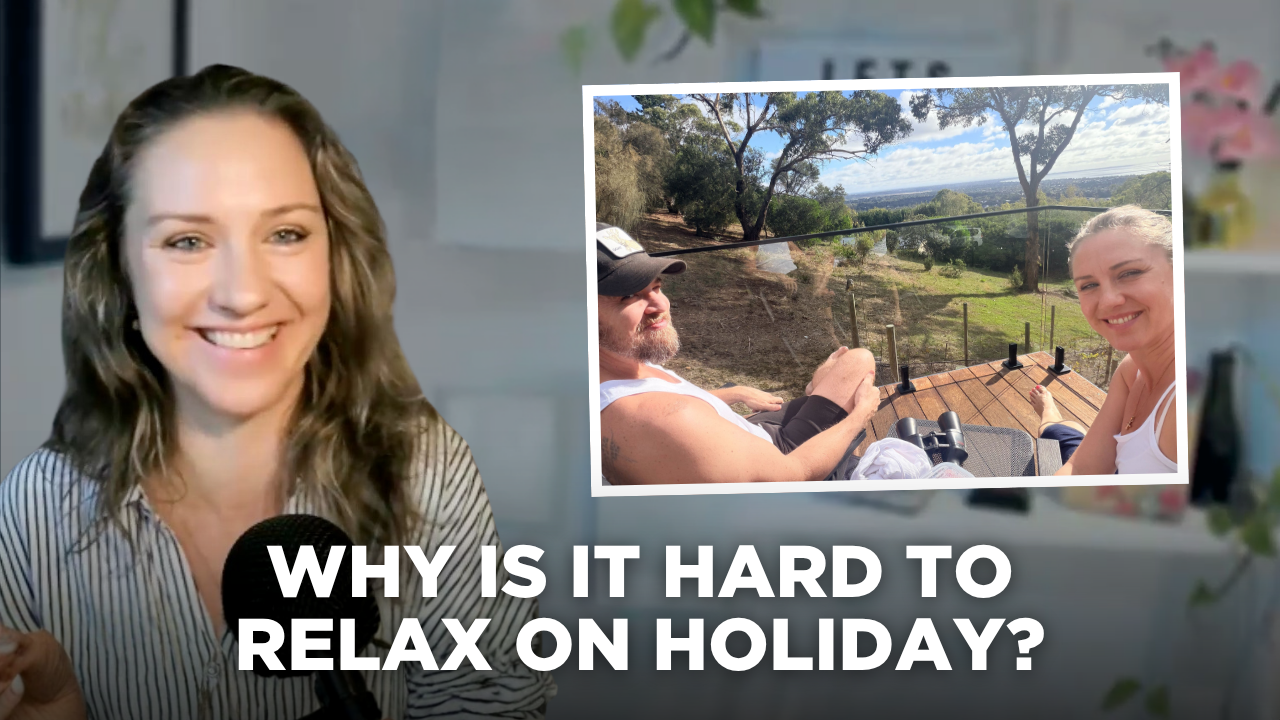
I noticed this myself on our last trip away. We had just come off a busy few months and I sat down by the fire, looking out over the ocean, and realized my breathing was still tight. Still bracing for the impact of stress.
I did not force it to change. I just noticed it. And allowed it to loosen up.
Something shifted. Not dramatically. But enough.
You Do Not Have to Wait Three Days
Most people assume that unwinding takes time. That the body needs a few days to catch up before you can really relax.
And sometimes that is true.
But part of what drives that lag is the habit itself.
The habit runs because it has been running.
It keeps going because nothing has interrupted it yet.
When you start to notice what the breathing is actually doing, and when you recognize the habit for what it is, something else becomes available.
You do not have to wait for the environment to do the work.
Sometimes just noticing is enough to change it.
You can find that settling even in the middle of a busy week, without needing to go anywhere.
That is what understanding your breathing habit actually gives you. Not a technique. Not a fix. Just more choice about whether the pattern keeps running.
A Final Thought
If you have ever come back from a holiday feeling like you barely got there, it is worth asking whether the habit followed you.
Not because something is wrong with you.
But because the body learned something. And what is learned can be recognized.
That is usually where it starts to change.
ON-DEMAND NOW AVAILABLE!
Behavioral Breathwork Training On-Demand
Learn how to understand breathing behavior in real time and guide it with clarity. This on-demand training gives you a practical, physiology-informed framework you can apply in your own practice and with clients.
SUBSCRIBE NOW!
Online Breathing Academy Newsletter
Join our newsletter for thoughtful conversations about Behavioral Breathwork, regulation, and how stress develops as a learned response.
This is where we share more context, more nuance, and the reflections that don’t always make it online.
We won't share your details. Unsubscribe at any time.