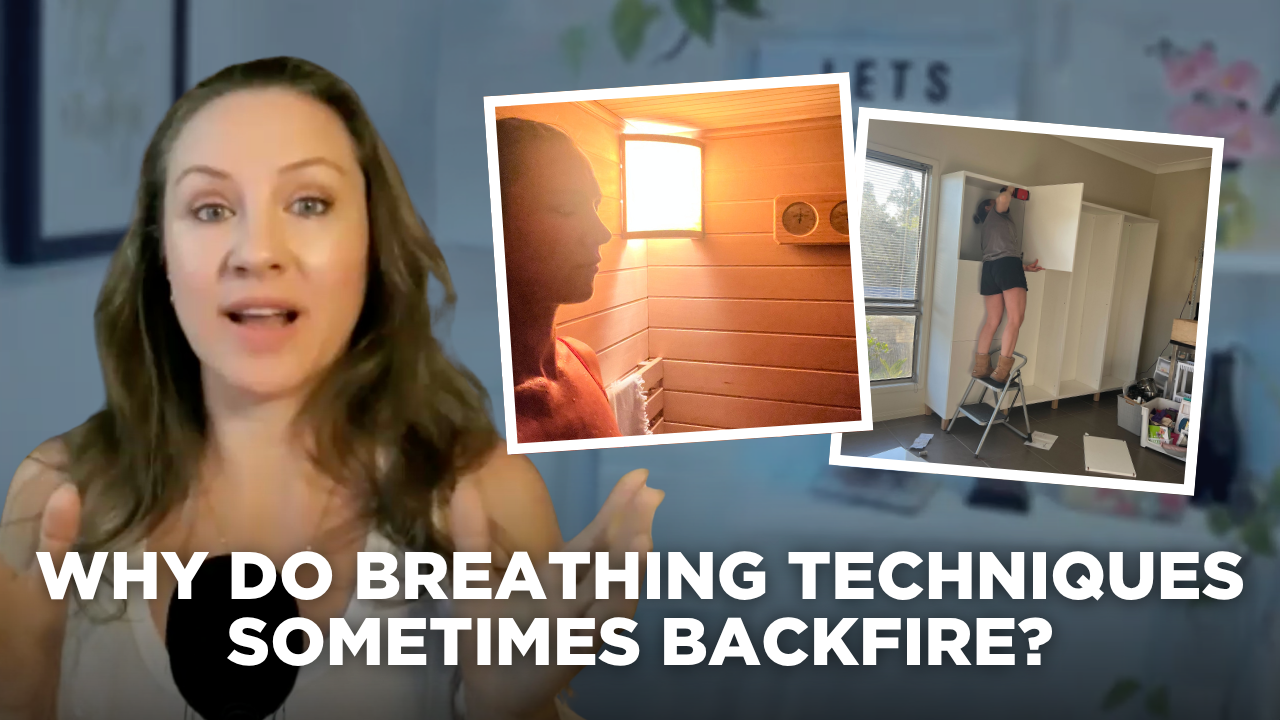
Why do breathing techniques sometimes backfire?
Written by Angie Saunders
You've probably tried at least one.
Box breathing. Circular breathing. A four-count inhale and a long slow exhale.
Maybe something you found on YouTube at 11pm when you couldn't sleep.
And maybe it helped. For a while.
But then it stopped working. Or it worked in the moment but nothing really changed outside that moment. Or worse, it left you feeling more stressed than before, more aware of your breathing in a way that felt uncomfortable rather than calming.
This is more common than most people realize.
And there's a reason for it that has nothing to do with doing it wrong.
What's actually happening
The body has a breathing reflex.
It runs automatically, adjusting to what the body needs moment to moment, breath to breath.
It doesn't need instructions. It doesn't need a count or a pattern. It has been doing this since the day you were born.
When we layer a technique on top of that reflex, we are essentially stepping in and overriding it. We are telling the body, consciously or not, that we don't trust what it's doing. And the body responds to that interference.
Dr. Peter Litchfield's work in respiratory behavioral science helps explain why.
Breathing behavior is governed by chemistry, specifically by carbon dioxide concentration in the blood. The reflex exists to regulate that chemistry moment to moment. When we take voluntary control of the breath, we can disrupt that regulation process, even when our intention is to feel better.
This is why techniques often work in the short term.
The act of paying attention to breathing does bring some awareness, and that awareness alone can shift something temporarily. But the underlying habit, the learned pattern of interfering with or overriding the reflex, keeps running.
The technique addresses the surface. The habit continues beneath it.
Over time, some people find that trying to control their breathing actually reinforces the very pattern they're trying to move out of. The body learns that breathing requires management.
And so… it keeps waiting to be managed.
What changes when you stop trying to fix it
There is a significant difference between observing the breath and controlling it.
Observation means noticing what the body is already doing.
Noticing the rhythm, the depth, the moment of transition between exhale and the next inhale. Not changing it. Just watching.
When people start doing this, something often shifts that no technique could do.
But it doesn't always feel good at first.
For many people, simply turning attention toward the breath creates discomfort.
The breathing starts to feel strange.
Some feel a creeping anxiety, a sense that something might go wrong if they stop managing it.
This is not a sign that something is wrong. It is actually evidence of the habit itself.
When someone has been unconsciously overriding their breathing for a long time, the act of observing it can feel threatening. The body has learned that breathing requires management. So the moment attention goes to it without a technique to follow, the system can interpret that as a loss of control.
The anxiety that shows up when you try to observe your breath is often the habit defending itself.
This is why understanding what is driving the habit matters so much.
Awareness alone can feel destabilizing.
But awareness with some understanding of what is actually happening, makes it something you can work with.
And when that understanding is there, the body begins to regulate itself more freely.
The reflex, which was always there, gets a little more room to do what it does best.
This isn't a technique.
It's the opposite of a technique.
It's learning to recognize when you're getting in the way, and then stepping back.
The question worth sitting with
Most people who come to breathwork have been told, in one way or another, that they need to learn how to breathe. That something is wrong with the way they breathe. That a technique will fix it.
What behavioral breathwork asks instead is: what habits has the body learned, and when did it learn them? What is the breathing doing, and why?
That shift in question changes everything.
It moves from correcting to understanding.
From doing to noticing.
From managing the body to building a relationship with it.
Techniques aren't necessarily harmful.
But when they become the answer rather than a temporary support, they can quietly reinforce the habit of not trusting the body's own intelligence.
The breath doesn't need to be fixed.
It needs the conditions that allow it to do what it already knows how to do.
ON-DEMAND NOW AVAILABLE!
Behavioral Breathwork Training On-Demand
Learn how to understand breathing behavior in real time and guide it with clarity. This on-demand training gives you a practical, physiology-informed framework you can apply in your own practice and with clients.
SUBSCRIBE NOW!
Online Breathing Academy Newsletter
Join our newsletter for thoughtful conversations about Behavioral Breathwork, regulation, and how stress develops as a learned response.
This is where we share more context, more nuance, and the reflections that don’t always make it online.
We won't share your details. Unsubscribe at any time.