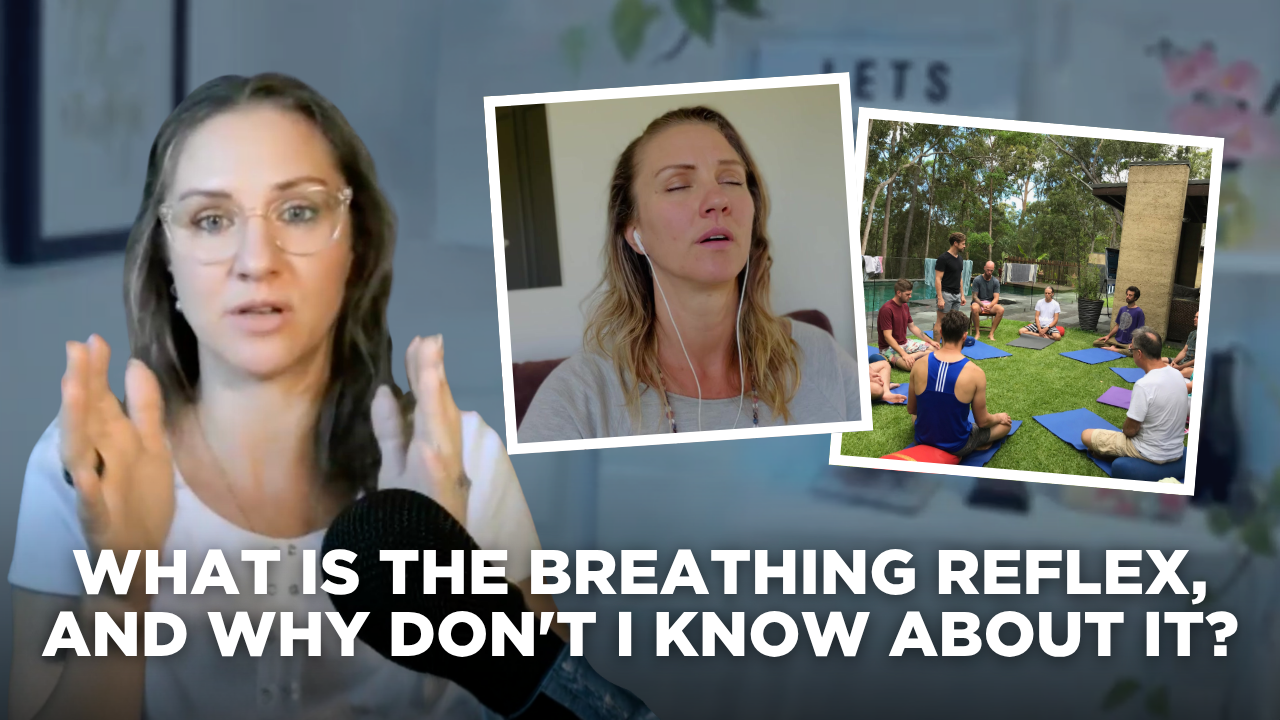
What is the breathing reflex, and why don't I know about it?
Written by Angie Saunders
What is the breathing reflex, and why don't I know about it?
If you have been studying breathwork for any length of time, you might have heard about breath awareness.
Noticing the breath. Observing what it does. Paying attention to how it changes with different breathing techniques.
And you have probably learned a lot about breathing techniques themselves, or what we would call interventions.
Box breathing. Circular breathing. Counting the breaths. Double inhale sighs. Alternate nostril breathing. Slow exhale practices. 4-7-8 breathing. Holotropic breathwork. Wim Hof method.
These are essentially tools for managing a specific state, hacking the body into a different mode, or creating a transformational experience.
And that is what breathwork is right now for most people.
Awareness and interventions...
The A and the I.
But there is a third piece that almost nobody teaches. And it changes everything.
Let me explain…
What A.I.R. actually means
Dr. Peter Litchfield, a psychologist with over 60 years of experience who specializes in breathing and behavioral science through his Professional School of Behavioral Health Sciences, developed a framework called AIR.
In Behavioral Breathwork, we use this framework and we call it:
Awareness. Intervention. Regulation.
In plain language: self-awareness, self-exploration (of interventions), and self-regulation.
Self-awareness is learning to notice what your breathing is doing.
Self-exploration is learning what happens when you intentionally change it.
Self-regulation is where the body learns to manage its own chemistry, automatically, without overriding it.
This is a way of working with breathing that is client-led, grounded in behavioral science, and built around understanding rather than prescribing.
Most breathwork trainings cover the first two parts... Awareness and intervention.
The third piece, self-regulation, is where most teachings stop short.
And the reason they stop short is because self-regulation requires understanding something most breathwork trainings have never introduced.
The Breathing Reflex.
Without the reflex, you stay in the intervention loop.
That means always reaching for a technique.
Always looking for the next technique or method.
And never quite arriving at the feeling you were looking for in the first place.
What is the breathing reflex?
The breathing reflex is the body's automatic mechanism for regulating CO2 chemistry, breath to breath, moment to moment.
It is brainstem-regulated.
It is chemically driven.
It adapts to what the body needs right now,
not what you think it needs.
At the end of every exhale, there is a small pause.
In that pause, CO2 builds slightly. The reflex detects that and calls the next breath in.
That is all it is….
And it is extraordinarily underestimated.
Peter describes it this way…
"You just need to allow the system to do its job. You don't have to learn how to do the regulation. You just have to learn to get out of the way of those reflexes so they can do the job."
When you override that reflex consistently, through deliberate breathing techniques, through holding, forcing, or controlling the rhythm, the body gradually learns that breathing requires management.
The reflex fades into the background.
Self-regulation becomes self-intervention.
And the techniques never quite get you where you want to go.
Peter puts it like this…
"All of us out here include breathing learning interventions in one way or another in our professional or personal lives. Most of these people, however, focus exclusively on mechanics, without understanding that breathing mechanics are behaviors, and without addressing the profound effects of these mechanics on the chemistry of respiration."
Why techniques alone will never get you to regulation
We look at it like this…
"Self-intervention is DOING the breathing. Self-regulation is BEING the breathing."
Breathing interventions are when you are doing something with the breath. Forcing a technique. Managing a state. Taking charge and deliberately doing something different.
And sometimes that is exactly what is needed.
Sometimes you do have to intervene, break a pattern, and do something different.
Self-regulation is the body managing its own chemistry automatically, without override.
It does not require effort. It does not require a technique. It requires trust.
Both have a place. Intervention is useful…
But it was always meant to be a temporary tool, something you reach for when you need it.
It was never designed to be how you live.
"Finding the reflex really means finding self-regulation," Peter says. And when people find it, the experience is unmistakable.
Brigitte, a Pilates teacher and breathwork facilitator of 25 years, shared this after going through our last Behavioral Breathwork Training:
"I've noticed that with the breathwork that I've been doing with you guys, I just don't seem to get caught up with it [stress]. It's a less visceral experience whenever I have stress. I'm able to be more calm."
That is what regulation feels like.
Scott, writing from Florida, described it this way after completing our Reflexive Breathing Experience:
"The reflexive teaching has been remarkable. Standing in anxiety-prone situations like a crowd at a cafe or restaurant, allowing the breath, I've been able to see how my exhale has been conditioned from childhood."
And Pamyla, one of our subscribers:
"Going back to the pause and truly allowing the breath to reset and guide has doubled my HRV. I also feel more present with everything."
Why most people never find the reflex
When things feel out of control, the body will unconsciously try to control things.
And it starts with the breath.
When the mind or the body experiences something uncomfortable, whether it is hunger for air, anxiety, or simply the discomfort of being still, so it might learn to avoid the pause entirely because it feels it needs to do something... So it fills the gap.
The unconscious mind will take the breath before the reflex has a chance to engage.
This is a learned habit. And past experiences influence it deeply.
Over time, the habit becomes automatic. The reflex fades into the background. And the person has no experience of what their body is actually capable of doing on its own, because they have always felt like they have to control everything.
Peter describes this clearly: "Clients learn to distrust their physiology. They think they have to do everything themselves. So clients unconsciously learn to take the breath, which deals with the problem. It takes care of that distrust."
And here is where it gets interesting…
Every time a breathing technique gives someone relief, it confirms that they need to keep doing it. That it is working.
So the habit of reaching for a technique gets stronger. The override gets stronger. And the person gradually disconnects from the reflex, trusting their own interventions more than the system the body was born with.
The body's own chemistry is designed to regulate breathing, moment to moment, automatically. When we override that system consistently, we are essentially telling the body that we can do a better job than it can.
When really, we cannot…
What changes when you connect with the breathing reflex
Peter describes what happens when someone actually experiences the reflex for the first time:
"When you allow it, breathing becomes easy because it happens automatically. And you don't have to exert yourself and you can feel your body knows exactly what to do. And now that allowing, you don't even have to think about allowing, it just happens automatically the way it did when you were born."
He calls this a conditioned reinforcement.
The experience of allowing the breath becomes something the body wants to repeat.
Trusting the reflex becomes its own reward.
And the implications go further than breathing.
"Allowing the breath may become a mega-reinforcement, where trust in one's own physiology may operate as a metaphor for trust in oneself."
This is what both Pamyla and Scott described that they experienced.
What this means for you personally
You don't have to be a breathwork facilitator for this to matter.
If you have ever felt like you are always having to do something. Always reaching for a technique or a remedy to feel better.
If you have noticed that breathwork helps in the moment but nothing seems to change long term.
If you have tried meditation and found that paying attention to your breath made you more agitated rather than bringing you peace.
If you have been told to just breathe and wondered why that never really works for you the way it seems to work for other people.
Then connecting with the breathing reflex might be the missing piece.
Most of us have spent years learning to override our breathing, especially the pause. The body's physiology is a learning system. It learns what works under pressure. When we feel the weight of life on our shoulders, we get very good at just surviving.
The body adapts. The habit becomes automatic. And somewhere along the way, we stop trusting the body because we feel like we have to control everything.
Connecting with the breathing reflex is not about adding another practice to your routine. It is not a technique to master.
You are breathing anyway. You might as well pay attention to how it is affecting you.
Sometimes it is as simple as noticing the pause at the end of the exhale. Noticing the urge to breathe. And staying connected with it long enough to feel what the body wants to do next.
Peter describes what tends to happen when people experience this for the first time:
"You can feel your body knows exactly what to do. And now that allowing, you don't even have to think about allowing, it just happens automatically the way it did when you were born."
For many people, that moment is the first time breathing has ever felt like something the body was doing for them, rather than something they had to do for themselves.
It is nourishing. And that is not just a metaphor...
When the reflex operates freely, CO2 chemistry rebalances. Blood flow improves. Oxygen delivery improves.
The body is literally nourishing itself with every breath that the reflex regulates.
That is what your body was designed to do.
All it needs is for you to let it…
What this means if you work with people
If your clients keep coming back week after week, always feeling like they are close but never quite getting what they are looking for, eventually they will move on and look for someone else who can help them get there.
What you want is a client who gets what they came for.
Who feels the difference.
And who tells other people about it.
That is a business that is sustainable.
It is worth looking into whether the breathing reflex has ever been part of the conversation with your clients.
When you teach awareness without the reflex, your clients become better observers of their breathing. That is useful, but it is only the first step.
When you teach techniques without the reflex, your clients get more tools.
That is useful too, but they stay in the loop of needing those tools.
When you introduce the reflex, regulation becomes available.
That is what Brigitte experienced…
That is what regulation feels like.
And it becomes available when you understand your own breathing reflex.
ON-DEMAND NOW AVAILABLE!
Behavioral Breathwork Training On-Demand
Learn how to understand breathing behavior in real time and guide it with clarity. This on-demand training gives you a practical, physiology-informed framework you can apply in your own practice and with clients.
SUBSCRIBE NOW!
Online Breathing Academy Newsletter
Join our newsletter for thoughtful conversations about Behavioral Breathwork, regulation, and how stress develops as a learned response.
This is where we share more context, more nuance, and the reflections that don’t always make it online.
We won't share your details. Unsubscribe at any time.