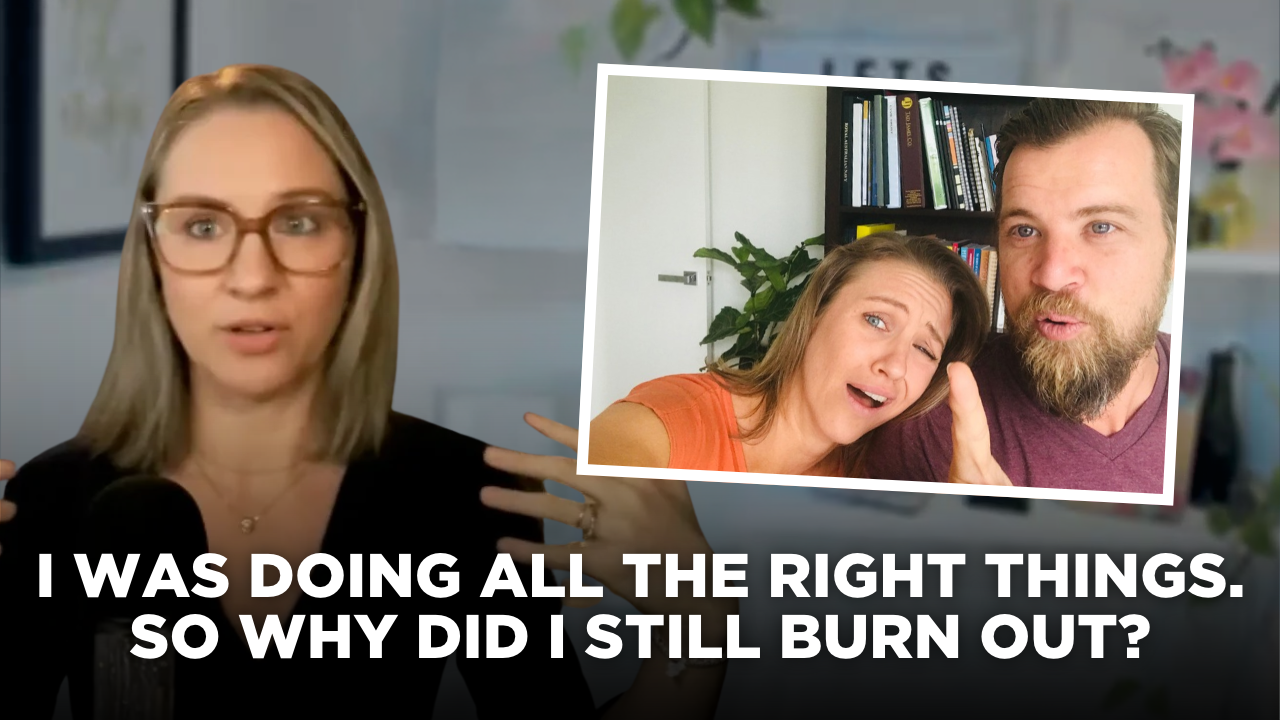
I was doing all the right things. So why did I still burn out?
Written by Angie Saunders
In our work, we meet a lot of people who give. Facilitators, coaches, health professionals, parents, business owners. People who hold space for everyone else and quietly move themselves to the bottom of the list.
I know that pattern well. I’m one of them.
And this year, it caught up with me.
My breathing was in a good place
After everything I’ve learned about breathing and behavioral science, I’ve gotten really good at regulating through stress. If anything, I can handle more now than I ever could before.
I’m a peacemaker at heart. What I’ve learned is that peace with the people around us starts with peace inside ourselves. I picture a world where more people can find that, in their own way. Sharing this gives my life purpose and meaning.
It’s also why I so easily burn the candle at both ends. I’d work late at night in bed on my laptop. I’d wake up early and squeeze in a few more hours before the kids were up.
There was a time when those hours were how we made the mortgage repayment. They mattered. But somewhere along the way, it became a habit. Even when I could have taken time off, I didn’t. There was always more I wanted to do.
I’m 44 this year, and for the first time, I started to feel tired. I told myself I was okay. Then one day I woke up and my body said I wasn’t. I ended up with really bad vertigo. I was sure it was a virus, but no, it was just vertigo. And it shook me completely.
Here’s what surprised me most. Looking back, I still felt well regulated. But there were other signs I started to notice. My heart rate variability had dropped, and my resting heart rate had crept up. Being able to handle so much is probably what kept me going for as long as I did. In hindsight, though, I wasn’t giving my body enough time to recover.
I was doing all the right things. How did this happen? What couldn’t I see?
Looking beyond the breath
When the body or mind feels off, we start with the basics. These are some of the foundations the body depends on, and when one of them isn’t being met, the body lets us know.
- Breathing
- Sleep, and daylight to set your body clock
- Hydration
- Movement
- Rest and recovery
- Living in line with what matters to you
- Nourishment
Sometimes the body tells us through the breath, with an irregular or labored breathing pattern. Sometimes it’s a niggle, an ache, or a restless night. And because the body works as a whole, the breath often changes along with whatever else is going on.
Breathing is first on the list, but it’s only one part. It’s also the one we’re most tempted to take control of. This part is important, so let me explain.
When we feel tired or stressed, it’s natural to reach for a technique. We call that self-intervention: taking control of the breath to change how we feel.
But the body already has a system for this. It’s called the breathing reflex. Sensors in the body keep track of the carbon dioxide in our blood and signal the brainstem, which adjusts how fast and how deeply we breathe. It happens breath by breath, below our awareness. It’s what keeps us breathing while we sleep, eat, or talk, without us ever thinking about it.
When we take over, it’s easy to breathe more than the body needs and throw that balance off.
Self-regulation is the alternative. It’s learning to get out of the way and hand the breath back to the reflex. It sounds simple, but it’s not always easy, especially if you’re used to being in control.
For me, it showed up in the behavior of my heart, and in a tiredness I couldn’t shake. In my early days with breathwork, I would have reached for a technique to push through. This time, I knew it wasn’t my breathing. I measured it, and my CO2 levels looked healthy. You can see me measuring it in this reel. So I kept digging.
It was more than one thing. I was sacrificing sleep, night after night, year after year, telling myself I could handle it and that it was worth it. But even when I started sleeping more, my heart rate variability wasn’t improving, and neither was my resting heart rate. When I finally had blood tests, my iron was low.
So it’s kind of about the breathing… and it’s kind of not.
One lens in a whole system
This is where Behavioral Breathwork has to be honest about what it is. It’s one lens in a whole system. It studies the breath and the body’s responses, and sometimes it points somewhere else that needs the right support.
Shane often describes the breath as the canary in the coal mine. Miners used to take a canary underground with them. The bird was more sensitive to toxic gases than they were, so if it got sick, they knew to get out before they felt anything themselves. It was their early warning.
The breath can work the same way. It’s threaded through everything else: sleep, circulation, recovery, the way we move through stress. So it can be one of the first places a problem shows up. But the body has more than one canary. This time, mine was my heart.
What I’m doing differently now
Sleep comes first now. I treat it as part of the work, rather than a reward for finishing it. Between an iron infusion and resting more during the day, my heart rate variability has improved.
I don’t work in bed late at night anymore, and I don’t get up before the kids to fit in a few more hours. I’m learning to work with my natural rhythm instead of forcing it.
For me, that daytime rest is a short reflexive breathing meditation. It’s my time to check in with my body, listen, and let go of everything on my list. If you’d like to try it, the 7-Day Reflexive Breathing Experience is a good place to start.
There’s a reason they tell you on a plane to fit your own oxygen mask before helping anyone else. I can’t share this work, or show up for my family, if my body doesn’t have the energy to do it.
I’ve learned that if I run my body down, it makes me stop. So I’m practicing paying attention to what my body needs before it has to shout for my attention.
The body is always talking. The work is to let the breath help quiet the noise, so we can get really good at listening.
We teach this in a lesson called Beyond Breathing, inside our Behavioral Breathwork Training. The updated on-demand version is coming soon. If you’d like to be the first to hear when it opens, join the waitlist here.
SUBSCRIBE NOW!
Online Breathing Academy Newsletter
Join our newsletter for thoughtful conversations about Behavioral Breathwork, regulation, and how stress develops as a learned response.
This is where we share more context, more nuance, and the reflections that don’t always make it online.
We won't share your details. Unsubscribe at any time.