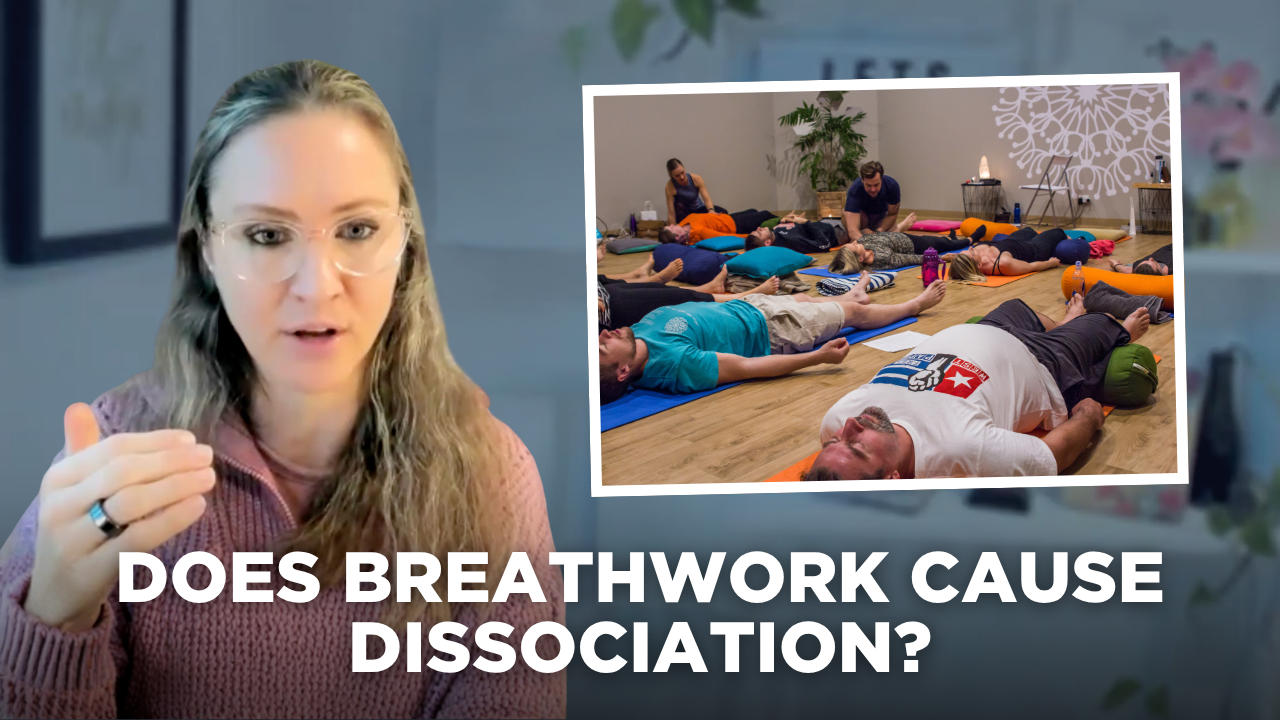
Does Breathwork Cause Dissociation?
Written by Angie Saunders
You probably know someone who swears by breathwork.
Maybe it's you.
A particular practice that reliably creates a feeling of space. Quiet. Release. A break from the noise inside.
For many people, that experience is the first real relief they have felt in years.
So they return to it. Again and again.
And then something slowly happens...
The sessions that used to feel amazing start to feel ordinary.
Feeling foggy, frazzled, tired or low-level flatness is not unusual.
Most people assume they need to practice more, find a better technique, or research a different remedy.
What's actually happening is very interesting…
The chemistry behind the feeling
Most breathwork techniques involve some degree of overbreathing or what some call hyperventilation… It’s controlled, rhythmic, vigorous breathing that shifts body chemistry in a predictable way.
When we overbreathe, CO2 concentration in the blood drops.
This matters more than most people realize.
CO2 is not simply a waste gas. It is the primary regulator of blood pH, and pH governs almost everything: blood flow, oxygen delivery, nerve activity, muscle function, and the chemistry of the brain itself.
When CO2 drops, blood vessels in the brain constrict. Oxygen delivery is impaired through what is known as the Bohr Effect, where reduced CO2 causes hemoglobin to hold onto oxygen rather than release it to tissues. Blood flow to the brain can be reduced by up to 40 to 50 percent.
In that state, consciousness shifts.
The mind goes quiet. There is a disconnection from the noise of ordinary thinking.
This is dissociation. It's more of a chemistry event than it is a spiritual phenomenon.
And for someone who lives inside a very loud head, that chemistry event can feel like a revelation… a spiritual experience.
These experiences are real. And for many people they are genuinely useful.
The problem is when it becomes a habit to breathe like this.
Keep following along and I'll explain…
Why the body learns to repeat it
Here is where behavioral science becomes essential to understanding what happens next.
Breathing is a behaviour. Like any behaviour, it is governed by outcomes. When a behaviour produces a result that the body or mind finds useful, it gets repeated. Over time, it becomes a habit.
When overbreathing produces a feeling of relief, release, or dissociation, the body logs that. The brain doesn't know or care that the relief came from a drop in CO2. It knows that a particular way of breathing produced something that felt good. And it begins to recreate that pattern, not just in sessions, but throughout the day.
This is what behavioral breathing science describes as a learned breathing habit. It doesn't require conscious intention. It doesn't require knowing it's happening. The body simply runs the pattern it has been reinforced to run.
The difference between a session and a habit
Ok, so this is my main point…
A single breathwork session that temporarily lowers CO2 is one thing.
A body that has learned to stay in a low CO2 state across the entire day is another.
The breathing reflex exists to regulate CO2 chemistry moment to moment, automatically, without interference. It is exquisitely sensitive. It adjusts breath to breath in response to chemistry, pH, oxygen concentration, and the demands of the moment.
When overbreathing becomes a daily habit, that reflex is being chronically overridden. The body is no longer self-regulating. It is running a learned pattern instead.
And chronically low CO2 produces a recognizable set of symptoms: Brain fog. Fatigue that doesn't resolve with rest. Poor memory and difficulty concentrating. Moodiness and emotional reactivity without a clear cause. A low-level anxiety that seems to come from nowhere.
These are not always the signs of stress or burnout or hormonal imbalance.
They are also documented symptoms of behavioural hypocapnia, a CO2 deficit sustained by a learned breathing habit.
And it’s worth taking into consideration.
Why techniques don't solve this
The instinct, when breathwork stops working, is to look for a better technique.
But the technique was never the problem.
What sustains a dysfunctional breathing habit is reinforcement. The habit continues because it is still serving some purpose, relief, control, dissociation, escape from discomfort, even if the cost of that service has grown.
Teaching someone a new breathing technique without addressing the habit underneath it is like giving someone a new way to cope without addressing the core issue of why the habit was formed in the first place. The old habit keeps running. The new technique adds another layer on top of it.
What changes things is understanding what the body learned, when it learned it, and what purpose it has been serving.
That is a fundamentally different kind of work than technique instruction. It requires looking at breathing as a behaviour. Understanding its triggers, its reinforcements, its history. And creating the conditions for the reflex to do what it was designed to do, without interference.
What this looks like in practice
When people begin to observe their breathing rather than manage it, something often shifts that no technique produced.
The body, given space to regulate itself, begins to do exactly that.
This is the difference between self-intervention and self-regulation. Self-intervention is doing something to the breath. Self-regulation is the body managing its own chemistry, freely, without override.
That is the goal of Behavioral Breathwork.
It’s not about finding the right technique...
It’s about understanding what breathing has learned to do,
and what it needs to be able to do instead.
ON-DEMAND NOW AVAILABLE!
Behavioral Breathwork Training On-Demand
Learn how to understand breathing behavior in real time and guide it with clarity. This on-demand training gives you a practical, physiology-informed framework you can apply in your own practice and with clients.
SUBSCRIBE NOW!
Online Breathing Academy Newsletter
Join our newsletter for thoughtful conversations about Behavioral Breathwork, regulation, and how stress develops as a learned response.
This is where we share more context, more nuance, and the reflections that don’t always make it online.
We won't share your details. Unsubscribe at any time.